

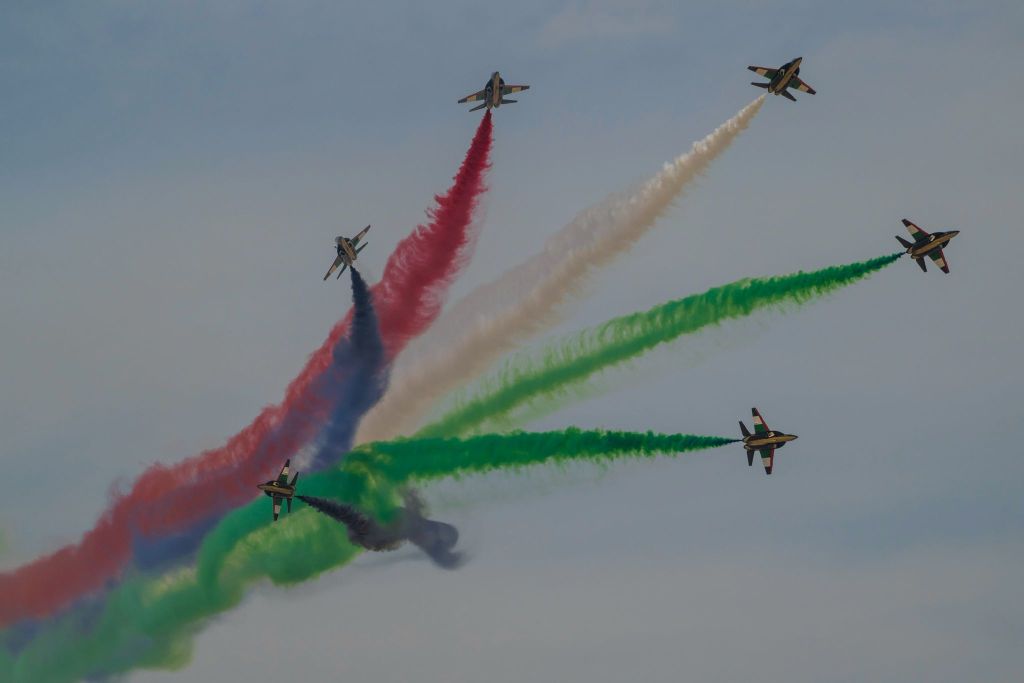
Dubai, is a middle of November day, and seven gold-and-black Knights ride across the blue sky of the Emirate city. They swoop down, riding falcons from the Far East, leaving intense trails with colors of United Arab Emirates (UAE): red, green, white, and black.
It’s early afternoon of November 17th 2025, at Dubai Airshow. The sky fills with the colors of the UAE flag, and the famous Fursan al-Emarat formation presents itself to the large audience and the aeronautical world with its new aircraft: the Hongdu L-15 “Lie Ying” (Falcon).
Fursan al-Emarat – History
The “Fursan al-Emarat” (the Knights of the Emirates), also known simply as “Al Fursan,” is the aerobatic team of the United Arab Emirates Air Force (UAEAF). Since the beginning of its aerobatic history in 2010, the team has flown seven Italian Aermacchi MB-339NAT jet trainers. In November 2025, after 15 years of spectacular maneuvers, they switched to a new aircraft: the Chinese Hongdu L-15 “Lie Ying.”
Formed als UAE Aerobatic Squadron on 29th october 2008 at Khalifa Bin Zayed Air College in Al Ain with plan to join in the 2011 Dubai Air Show, with a fleet of 10 Aermacchi MB-339NATs, the team has also received the support of instructors and pilots from the Italian Frecce Tricolori. In fact, in 2010, they were guests of the famous Italian team for a training period at Rivolto Air Base (Udine, Italy), home of the 313th Group. Italian Air Force aerobatic training/313° Gruppo Addestramento Acrobatico.
28th February 2011 UAE Aerobatic Squadron is relocated to Minhad Airbase in Dubai and after the end of the training course in italy, the Al Fursan performed at the 2011 Dubai Airshow. On 20th May 2014 finally the teams name is changed from UAE Aerobatic Squadron to the actual Fursan Al Emarat Squadron.
Aermacchi MB339NAT
Aermacchi MB-339 is an advanced trainer and light tactical support aircraft produced by the Italian company Aermacchi (now Leonardo) since the 1970s. The Al Fursan version is called NAT – National Aerobatic Team and is a converted version of the MB-339A with characteristics similar to the PAN version of Frecce Tricolori.
Livery

The “Al Fursan” aircraft are painted in black, gold, white, red, and green. The main colors of the livery are black and gold, representing the golden sands of the desert and the black oil that hides beneath them. For their aerobatics, they are also equipped with smoke generators that produce trails of red, green, white, and black (the colors of their national flag).
With 2025, the time has come for the Emiratis to replace their aircraft with a more modern one, capable of expressing the skills of Arab pilots, a new aircraft and a new livery. And having abandoned the Italian aircraft, they couldn’t leave without the Italian touch on the new aircraft as well. In fact, for new livery of the Hongdu L-15s, a renowned Italian design studio was chosen: AircraftStudioDesign, led by Mirco Pecorari.
AircraftStudioDesign
AircraftStudioDesign, founded by Mirco Pecorari in 1989, boasts collaborations with other famous international aerobatic teams. Their portfolio includes the liveries of the Royal Jordanian Falcons’ Extra330s and the commemorative liveries of the Frecce Tricolori, as well as designs for manufacturers such as Pilatus, Dassault, Embraer, Bombardier, Boeing Business Jet, and even the italian Leonardo Company.
Some models are exhibited in the world’s most prestigious museums (including the Science Museum in London and the Smithsonian National Air and Space Museum in USA). Mirco Pecorari’s team has designed over 1,000 liveries, spanning aviation, nautical, and automotive sectors.

For Al Fursan, the AircraftStudioDesign team spent nearly two years implementing 3D technology and augmented reality headsets to present the Arab team with a dynamic and impressive design that interprets the colors and values of Emirates through flowing lines, reflective surfaces, and proportions designed to amplify the perception of movement in flight. This work involved close collaboration with the pilots themselves to achieve a result that provides them with the visual cues they need during their maneuvers. Each individual line or color can help the pilot better follow the aircraft that is flying alongside or ahead, making it easier to interpret distances and references for safe maneuvering during displays.
Mirco Pecorari
Designing a livery is art, precision, and technology. “Designing the new Fursan al-Emarat livery was an honor, but also a challenge. I had the opportunity to convey my design philosophy, which is always to give a profound and symbolic meaning to each livery. I wanted to create something that was not only beautiful, but that spoke to the country, its energy, its ambition; a design that visually represented the union of the seven Emirates” says Mirco Pecorari, Founder and Chief Designer at AircraftStudioDesign.
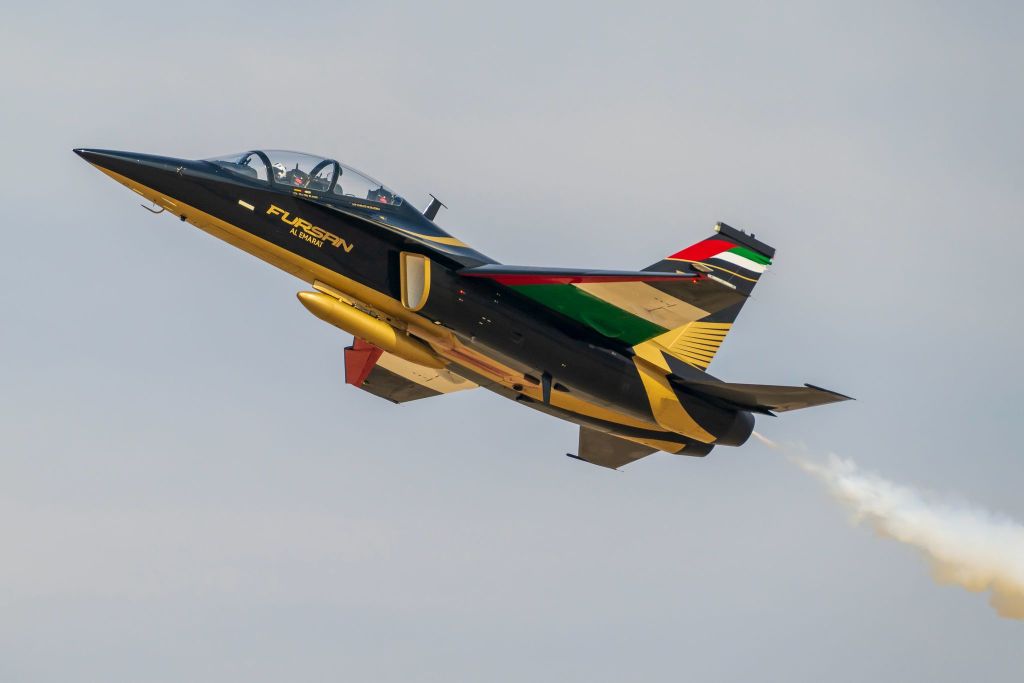
Seven lines intertwined in an elegant intersection symbolize the union of the seven Emirates. The golden stripes evoke the Color of Desert Sand, while the black background stands for the important resource of Oil. This livery is the visual passport of the United Arab Emirates Air Force Aerobatic Team.
7 Falcons
A visual passport to recognize seven golden knights in the sky, riding seven falcons from Far East. The new Hongdu L-15 “Lie Ying” is a 4th and half-generation advanced trainer aircraft produced by the Hongdu Aviation Industry Corporation of Nanchang (China). Founded in 1951 and known as China Nanchang Aircraft Manufacturing Corporation (CNAMC), Hongdu is part of the Aviation Industry Corporation of China (AVIC), a conglomerate that has been involved in China’s military aviation industry since the 1950s.

Hongdu L-15 “Lie Ying”
United Arab Emirates Air Force had already signed an initial agreement in 2022 for the purchase of 12 L-15s to replace the Italian aircraft serving with Al Fursan, and with a statement from UAE Air Force Col. Abdulnaser Al Humeidi (als official spokesman at Unmanned Systems Exhibition – UMEX with Simulation and Training Exhibition – SIMTEX in Abu Dhabi), the total order would have risen to 36 aircraft (at the end of October 2024, the UAE had 48 L-15s on order – ed.).
“The advanced features of the Chinese aircraft can facilitate the transition of pilots training on 4th-generation fighters and then on 5th-generation ones” Col. Abdulnaser Al Humeidi stated.
The Hongdu L-15 “Lie Ying” can also be used as a light ground attack fighter and, with limited capabilities, also in the air-to-air role.
Fursan al-Emarat in a new era
Since November 17th, Fursan al-Emarat have also performed at other events, and in the future, we would be delighted to see them perform in the skies around the world, carrying the colors of their nation, the mastery of Arab pilots, and the art of Italian designers. After flying Italian aircraft and collaborating with the Italian national aerobatic team, they will not abandon the boot-shaped peninsula, but will continue to maintain the Italian touch with the prestigious designs of AircraftStudioDesign of Modena.
Fursan al-Emarat and their new flying jewels will amaze us with excellent maneuvers decorated with their smoke trails in the colors of the UAE flag, exploiting all the maneuvering capabilities of this particular modern aircraft and highlighting the skills of Emirati pilots.
from BSA HQ Switzerland: Daniele Maiolo
Photos courtesy of AircraftStudioDesign and Fursan al-Emarat
Link:
Fursan Al-Emarat web Page
AircraftStudioDesign site
Dubai Airshow
Gallery:



Scopri di più da Best Shot Aircraft
Abbonati per ricevere gli ultimi articoli inviati alla tua e-mail.
 Best Shot Aircraft